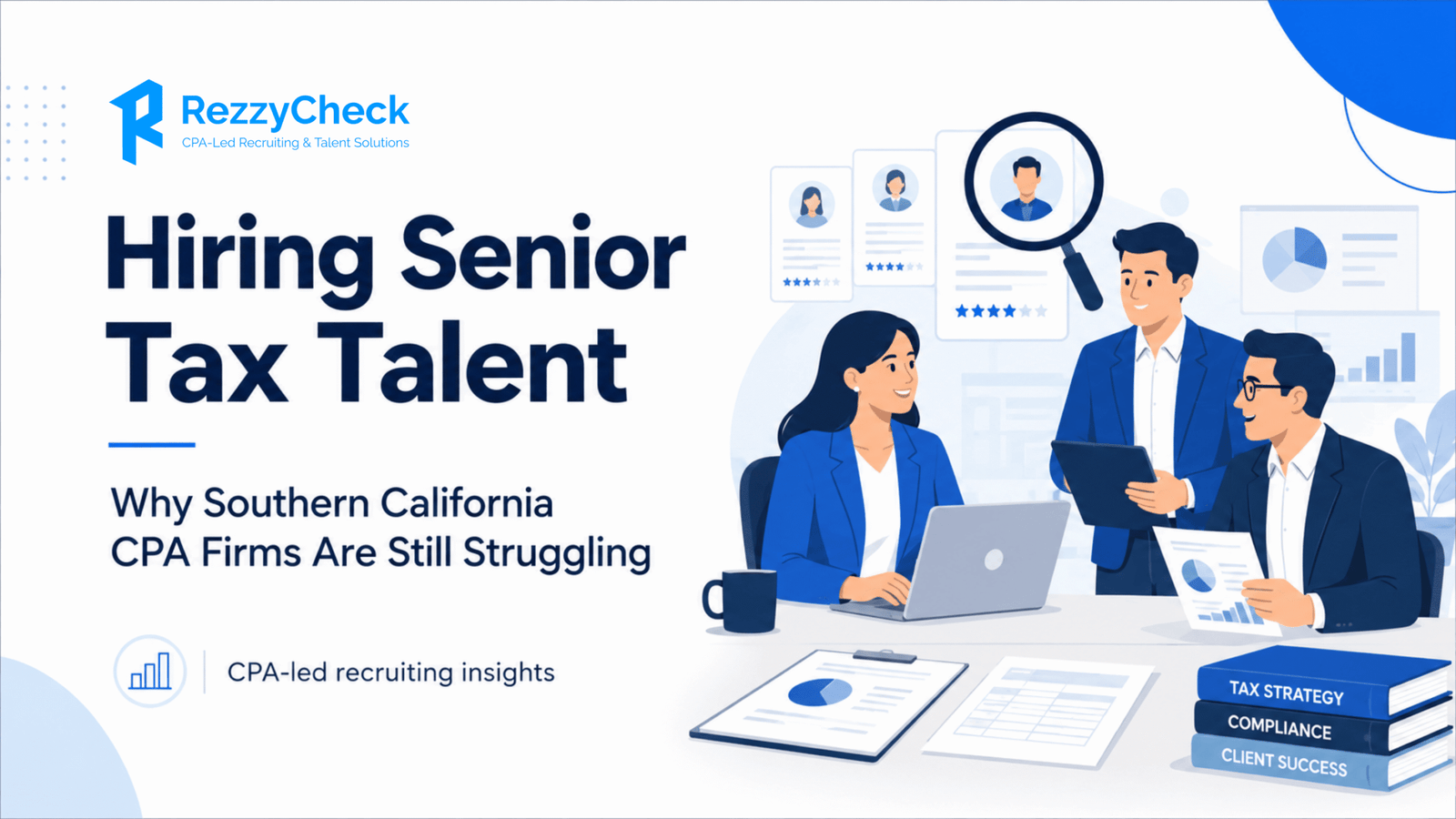
Why Southern California CPA Firms Are Still Struggling to Hire Senior Tax Talent
AI is everywhere. PE money is still moving through public accounting. Offshore teams are part of the conversation. Still, a lot of CPA firms have the same hiring problem they had last year: they need strong Senior Tax Associates and Tax Managers who can do the work, communicate well, and stay.
Here’s what I’m seeing in the tax hiring market
I talk to public accounting tax candidates and CPA firms across Southern California almost every week.
The market feels odd right now.
Firms are reading about AI, automation, offshore staffing, private equity, mergers, and Big 4 layoffs. Some headlines make it sound like the talent issue is about to disappear.
I’m not seeing that, at least not for experienced tax roles.
That’s the problem at the Senior Associate, Manager, and Senior Manager level.
Entry-level hiring matters. The CPA pipeline matters. AI adoption matters. But if your firm needs someone who can step in before next busy season and take pressure off the partners, you’re still competing for experienced tax talent.
Source note: recent reporting suggests accounting student interest may be improving, but that doesn’t immediately solve the experienced-hire problem for firms that need seniors and managers now. Read the source article.
Why senior tax recruiting is so hard
Senior tax associate recruiting and tax manager recruiting are hard because the best people usually aren’t sitting around applying to jobs.
They’re busy. They’re cautious. They’ve heard every firm say some version of:
- Great culture
- Work-life balance
- Growth opportunity
- Partner track
- Strong team
- We’re different
Most candidates don’t believe those phrases without details.
If a firm reaches out with a generic job description, strong candidates usually ignore it or assume it’s more of the same.
The real question is simple:
If the answer isn’t clear internally, it won’t be clear to the candidate either.
The hard part is the middle of the team
Staff can help with preparation.
Partners can bring in work, manage relationships, and make high-level calls.
The day-to-day pressure usually sits in the middle:
- Senior Tax Associates who can prepare complex returns without constant hand-holding
- Tax Seniors who can start reviewing simpler work and help train staff
- Tax Managers who can own client communication and keep projects moving
- Tax Senior Managers who can operate close to partner level
- Future partner-track candidates who can help with succession
A good Senior or Manager doesn’t just fill a seat. They make the rest of the team better.
They reduce partner bottlenecks. They improve review flow. They help staff grow. They keep clients from feeling the firm’s internal staffing issues.
Small firms can still win, but they need a clearer story
This is where I see smaller Southern California firms struggle.
They’re not only competing with the firm across the street. They’re competing with larger firms that can offer remote or hybrid schedules, bigger benefits packages, more recognizable names, and more complex client work.
That doesn’t mean the larger firm is always the better opportunity. Plenty of smaller firms have a much better story.
The problem is they don’t always tell it clearly.
- More partner access
- More face time with clients
- Less bureaucracy
- Better compensation for the right person
- More flexibility once trust is built
- A faster path to ownership or leadership
- A cleaner, more stable team environment
Those are real selling points. They just need to be specific.
I’ve also seen the “unicorn candidate” problem play out in real time. A local firm rejected a candidate because they wanted someone more “Big 4 caliber.” The candidate was picked up by Deloitte the next day.
That’s the irony. Some firms say they want Big 4-caliber candidates, but the role, compensation, flexibility, process, or candidate experience doesn’t always match what those candidates expect.
If a smaller firm wants to compete for that level of talent, it can. But it has to explain why the candidate would be better off there than at a larger firm.
What tax candidates want in 2026
Most candidates I talk to aren’t expecting public accounting to become a 35-hour-a-week job.
They know deadlines exist. They know busy season is real. They know clients can be demanding.
They’re looking for a better tradeoff.
1. Honest hours
Candidates don’t need to be told busy season is easy. They need clear expectations around billable hours, deadline weeks, flexibility, and how the firm manages workload.
2. Better structure
A lot of people aren’t only leaving for money. They’re leaving because their current firm feels chaotic, reactive, understaffed, or poorly managed.
3. Real growth
Seniors want to know how they become managers. Managers want to know whether they’re being developed or just used as production capacity.
4. Competitive pay
Compensation still matters. A small raise usually isn’t enough to make a strong tax candidate take on the risk of changing firms.
5. Better clients
Good candidates care about the work. They want to know the client mix, return complexity, industries, review expectations, and whether they’ll keep growing technically.
6. A reason to trust the process
Passive candidates are skeptical. They need specifics. The more clearly a firm explains the role, the easier it is for a candidate to take the conversation seriously.
Hiring before busy season? RezzyCheck can help you talk through the role, comp range, candidate pitch, and interview process before you start spending time with the wrong people. Book a quick call.
Where firms lose strong candidates
Most firms don’t lose candidates because they’re bad firms.
They lose candidates because the hiring process doesn’t match how experienced candidates make decisions.
Waiting for perfect applicants
For senior-level tax roles, the perfect candidate may never apply.
Strong candidates usually need to be found, approached, educated, and guided through the process. If the plan is mostly job boards, the firm is probably missing a large part of the market.
Moving too slowly
Strong candidates notice delays.
If scheduling takes too long, feedback is vague, or compensation gets pushed off until late in the process, candidates start making assumptions.
Sometimes those assumptions are wrong. Sometimes they’re fair. Either way, speed matters.
Being too vague about the role
“Tax Manager” can mean a lot of things.
Is the role heavy review? Heavy client contact? Staff training? Complex partnerships? HNW? Real estate? Trusts? SALT? Provisions? Business returns?
Candidates need those details early.
Selling the firm too late
Some firms treat the first interview like a one-way evaluation.
That can work with active applicants who urgently need a job. It doesn’t work as well with passive candidates who already have one.
The best interviews still evaluate the candidate. They also give the candidate a reason to care.
Assuming AI or offshore support fixes the people problem
AI and offshore teams can help with capacity. I’m not anti-technology, and offshore staffing isn’t going away.
Those tools usually make strong managers more important.
Someone still has to review the work, manage quality, train staff, communicate with clients, and know when something doesn’t look right.
What I’d review before recruiting for a senior tax role
If your firm is hiring Senior Tax Associates, Tax Managers, or Tax Senior Managers in Southern California, I’d get clear on these items before going to market.
- What technical experience is actually required?
- What’s nice to have, but not a dealbreaker?
- What client mix will this person handle?
- What’s the billable hour expectation?
- What does busy season really look like?
- What’s the compensation range?
- What does growth look like after year one?
- Why would someone leave their current firm for this?
This sounds basic, but it’s where a lot of searches get messy.
If the role isn’t clear internally, it won’t be clear to candidates.
I’d also write out the candidate story in plain English. If someone is currently at a larger firm with hybrid flexibility, stronger benefits, and more recognizable clients, why should they take your call? The answer might be partner access, compensation, client exposure, culture, flexibility, or a faster path forward. But it needs to be said clearly.
Be honest about the tradeoff
Every firm has tradeoffs.
Some firms have better hours but less technical complexity. Some have great clients but heavier deadlines. Some have a real partner path but require more in-office time. Some have better structure but less flexibility.
That’s fine.
The goal isn’t to pretend the firm is perfect. The goal is to be clear enough that the right candidate can make an informed decision.
Screen for motivation, not just keywords
A resume can tell you where someone worked.
It won’t tell you why they’d move, what they’re worried about, what compensation they need, whether they’re serious, or what they’re comparing you against.
Candidate motivation matters a lot in CPA firm recruiting.
Treat recruiting like client service
Candidates notice responsiveness.
Fast scheduling, clear feedback, prepared interviewers, and direct communication all send a message about how the firm operates.
For a passive candidate, that message matters.
Related: if you want help with tax recruiting in Southern California, here’s how RezzyCheck supports CPA firms.
How RezzyCheck helps CPA firms hire tax talent
RezzyCheck is CPA-led recruiting for accounting professionals.
That matters because tax recruiting is technical, but it’s also personal. You have to understand the role and the person.
A generic search can find keywords. A better recruiting process looks at fit.
- Does the candidate actually understand the work?
- Does their tax background match the firm’s client base?
- Are they serious about making a move?
- What are they really looking for?
- What concerns should be addressed early?
- Can the firm realistically close them?
- Does this look like a long-term fit?
For small and mid-sized CPA firms in Southern California, that can make a real difference.
You may be competing with larger firms, national brands, PE-backed platforms, and firms offering more remote flexibility. You can still win, but the message needs to be clear. If the firm offers more partner access, better client exposure, stronger compensation, or more flexibility than the candidate expects, that needs to come through early.
Final thought
Public accounting hiring is changing, but firms still need strong people.
AI may reduce repetitive work. Offshore teams may help with capacity. Consolidation may change firm structures. Experienced tax professionals who can review, manage, communicate, and lead are still hard to replace.
If your firm is trying to hire Senior Tax Associates, Tax Managers, or Tax Senior Managers, you’ll have a better shot if you understand the candidate mindset, move with intention, and give strong candidates a clear reason to engage.
That’s the work RezzyCheck helps with.
Hiring tax talent in Southern California?
RezzyCheck helps CPA firms hire stronger tax professionals through CPA-led recruiting, practical screening, candidate coaching, and a better understanding of what experienced public accounting candidates are actually looking for.
If your firm is hiring Senior Tax Associates, Tax Managers, or Tax Senior Managers, let’s talk.
Sources and context
This article was informed by recent Google Alerts reviewed by RezzyCheck, including alerts related to AI in public accounting, accounting firm layoffs, AI tools for CPA firms, and public accounting workforce shifts. Additional market context came from the sources below.
- Business Insider: Accounting has had a talent problem for years. It’s finally looking up, for now.
- Financial News: Accounting and consulting bosses on 2026 and agentic AI
- Kiplinger: CPA firm consolidation, outsourcing, and tax coordination risks
- The Guardian: PwC US CEO comments on AI adoption and professional services
- The Wall Street Journal: New accounting firm targeting automation
Book Now - it's free!